
US reoccupation would need large troop deployments, break the Doha Agreement, and strain relations with Pakistan, Russia and Iran.
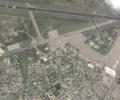
India's strikes on Pakistan damaged runways and structures across at least six airfields, according to a visual analysis by The Washington Post, which experts said were the most significant attacks of their kind in decades of simmering conflict between the two nations.

This is the first time in decades that China has made its flight test of an intercontinental ballistic missile public in an apparent show of strategic deterrence, State-run China Daily reported.

With this new induction, the country has the capability to launch nukes from land, air and sea.
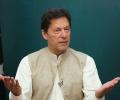
Pakistan's nuclear arsenal is 'simply a deterrent' to protect the country and there will no longer be any need for it once the Kashmir issue is resolved, Prime Minister Imran Khan has said as he asserted that if the Americans have the resolve and the will, the issue can be sorted out.

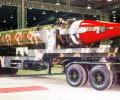
The Ababeel missile brings many Indian cities within its range.
According to the report, Russia tops the table with 6,375 warheads, followed by the United States with 5,800, and the United Kingdom with 215 warheads.

Musharraf also recalled that he had many sleepless nights, asking himself whether he would or could deploy nuclear weapons, the Japanese daily Mainichi Shimbun said.

The government started the crackdown against such YouTube channels for the first time in December last year using its emergency powers under the Information Technology Rules, 2021.

'With two nuclear neighbours, how likely is it for our armed forces to battle in a contaminated environment that could include nuclear, biological or chemical attacks by the adversary?' 'Are we prepared for the threat?' Brigadier S K Chatterji (retd) explains the meaning and significance of Operation Vijay Prahar.

India has added roughly 10 nuclear warheads for a total of 90 to 110 in 2012; Pakistan has increased its warheads by about 10 to between 100 and 120; and China now has 250 against 240 in 2012, the Stockholm International Peace Research Institute (SIPRI) said in its annual report.
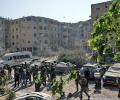
At the end of the day, for many worldwide, the ongoing mutual attacks between Israel and Iran would seem a contest devoid of any moral high ground and only a bout between two ordinary adversaries, one that nevertheless risks spinning out of control into a larger conflagration, notes Shyam G Menon.
China has flight tested an upgraded version of its 10,000-km range Dongfeng missile which can reach most of the US and European cities, demonstrating its nuclear capability, media reports said.
As tensions mount in the Gulf over Iran's nuclear ambitions, Israel is reported to have armed its new fleet of submarines supplied by Germany with nuclear tipped cruise missiles.

"Bad actors" cannot be allowed to have nuclear weapons at the cost of those trying to maintain peace and safety, United States envoy to the United Nations Nikki Haley has said.

India and the US have collaborated through the past one month on launching a powerful satellite; are commencing joint production of GE Aerospace's F414 jet engines in India; India is participating in a massive three week-long military exercise in the Western Pacific, observes Ambassador M K Bhadrakumar.
Yusuf Raza Gilani, despite being Pakistan's elected prime minister, has little or no control over the country's nuclear arsenal and the armed forces, explains Amir Mir

Indian policymakers must incorporate in their nuclear doctrine a realistic response to tactical nuclear warheads, says Ajai Shukla.

The study also said that the war would plunge the world into a "nuclear winter" that could lead to global climate catastrophe.
The latest report by Congressional Research Service -- a research wing of the US Congress that prepares reports for Congressmen - has confirmed the recent statements and media reports that Pakistan was expanding its nuclear arsenal.
"The United States and Chinas Asian neighbours remain concerned about the pace and scope of Chinas current military modernisation efforts, including its quantitative and qualitative modernisation of its nuclear capabilities," the Obama administration said in its Nuclear Posture Review report released by it on Tuesday.
As of today, there are nine countries generally recognised to own nuclear weapons, with Iran actively seeking to join this group.
The Babur or Hatf VII missile can carry conventional as well as non-conventional nuclear warheads.

In a year bookended by intractable conflicts and geopolitical fragmentation, India focused on ramping up military prowess by broadly firming up defence procurement worth Rs 4.22 lakh crore even as Indian and Chinese militaries completed pulling back their troops from border face-off points in eastern Ladakh.

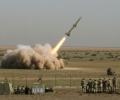
Pakistan on Monday successful test fired the short-range surface-to-surface Hatf IX missile.
Pakistan has approximately 60 nuclear warheads in its arsenal, although the figure could be higher, according to a report by the Congressional Research Service.The report states that Pakistan "continues to produce fissile material for weapons and appears to be augmenting its weapons production facilities, as well as deploying additional delivery vehicles -- steps that will enable both quantitative and qualitative improvements in Islamabad's nuclear arsenal."
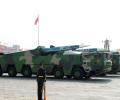
On Thursday, the Chinese military published its ICBM launch photos, shedding its secrecy.
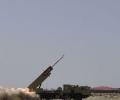
The military described the test of the "indigenously developed short range, surface-to-surface multi-tube missile Hatf-IX" or Nasr as successful.
India's defence establishment is taking the new Chinese threat seriously, as also that posed by Pakistan's nuclear-tipped MRBMs -- like the Ghauri-2 and the Shaheen-2 -- which can strike targets 2300 kilometres away.

The new treaty will require the United States and Russia to reduce -- by 30 per cent below the levels in a treaty signed in 2002 -- the number of nuclear warheads they have deployed on intercontinental ballistic missiles, submarine-based ballistic missiles, and bombers.
He, however, said that India and Pakistan are proceeding with the composite dialogue process, which has led to reduction of tensions and resulted in several Confidence Building Measures.

We bring forth to our readers the list of nations sitting on a nuclear stockpile, based on the study findings:
The move came as the United States and its European allies are believed to have faced resistance in pushing their case for referring Iran's nuclear activities to the United Nations Security Council.

India and Pakistan are reportedly expanding their nuclear arsenal, despite a global trend towards disarmament, the Stockholm International Peace Research Institute has said.
India on Sunday successfully test fired its nuclear-capable ballistic missile 'Dhanush', with a range of 350 kilometers, from a naval ship off the Orissa coast.
Iran is also defying UN demands to suspend uranium enrichment and is producing more powerful centrifuges, the International Atomic Energy Agency said in a strongly worded report, which is bound to renew demands from the US and its western allies for tougher sanctions against Tehran. The report is yet to be released officially, but is said to accuse Iran of not providing all information, especially relating to 'high explosives testing' relating to nuclear programme.
The government has been pushing ahead with the programme while claiming that no decision has been made on a successor to Britain's Trident nuclear deterrent, The Sunday Times reported.
After a series of setbacks in recent years, Russia on Thursday successfully tested its next-generation submarine launched intercontinental ballistic missile with multiple nuclear warheads.

The idea of weaponization got a fillip from an unexpected quarter. In the last week of October 1985, Rajiv met US President Ronald Reagan. Reagan told Rajiv, 'Pakistan has already made a bomb.' When Rajiv started talking about disarmament, the US president cut him short, 'Don't talk theory, think of your own protection.'
India must re-negotiate its nuclear deal with the US in order to save its strategic interests, former national security adviser Brajesh Mishra said Tuesday night.
